Saturday, April 30, 2005
monkeyshines










Thursday, April 28, 2005
Petition to help Tokyo homeless

From my friend Kim
-----------------------
Dear friends,
I am sending a petition being circulated by homeless and non-homeless activists throughout Japan - to protest Tokyo's recent move to “cleanse” parks of homeless persons who stay there. Please see the translation of the original Japanese text below for our collective stance. The ability of homeless persons to collectivize and create safe communities in public parks up till now has been an immeasurable resource for both their own physical and mental health as well as their capacity to reach out to others (and organize!). Should the ordinance (see below) pass, the city of Tokyo will be setting dangerous precedents.
First, if we allow the existence of tents (and their residents) to be debated as a problem solve-able by banning “offensive”people/matter from park environments, public discourse will increasingly be diverted to valuing the health of “parks” and “public properties” over that of fellow citizens.
Secondly, superficial benefits to “having nice public spaces”will lead to a chain reaction of prohibition ordinances across Japan, thus seriously threatening the lives of thousands of men and women who may ultimately be forced to live fluidly on the streets.
I ask for any and all organizations and individuals concerned with this issue to contact me (raru@jweb.co.jp) as soon as possible with your name(s) so that I may add them to the petition; we will be using it for active lobbying in the local and national Diets, as well as for campaigns to stir greater public understanding. Please feel free to contact me with any questions as well.
Thank you!
Rayna
PS see the original Japanese version at:
http://www7a.biglobe.ne.jp/~ninja/seimeipic.gif or
http://www7a.biglobe.ne.jp/~ninja/seimei2.pdf
::::::::::::::::::::::::::::::::::::::::::::::::::::::::
HELP US FIGHT city ordinances shutting the homeless out of public parks!
Staying in parks MUST NOT be made illegal!
Our organization, Koen-no-Kai (The Park Collective), is made up of individuals, both homeless and non-homeless, and organizations - all working to support homeless persons in Tokyo. On October 8, 2004, Tokyo governor Ishihara made it clear at a press conference that he is thinking of revising city ordinances to prevent homeless persons from staying in city parks. Newspapers informed the public that, “As soon as preparations for transitioning [the homeless] have been set…we will make the prevention of settling [in parks] a solid policy… if this takes effect, it will be the first such move anywhere in the nation,” and “Measures against violators will be strict.”
However, this ordinance contains a great number of problematic points:
1) In his public address, the Tokyo governor has shown no consideration for actual conditions that the homeless face. First of all, Governor Ishihara fails to understand the difficulties homeless people struggle with to survive. This can be seen in his past statements (some equating the homeless with “free spirits”) such as “after three days living in the open, people just get hooked; they can’t stop”. Today in
Japan, there are over 25,000 persons living on the streets. Once one becomes homeless, the lack of an address makes it nearly impossible to find work. Without work, one cannot find a place to live. Furthermore, social welfare administrations in Japan are not providing Japanese citizens even the minimal
level of subsistence as guaranteed in the Constitution.
Evictions, as well as the removal and destruction of personal belongings are now being carried out by government administrations across the country. These actions deprive the homeless of their place to sleep - fundamental to their right to exist and survive, and also deprives them of their personal possessions - fundamental to their personal and social lives.
For example, on October 29, 2004 the east Tokyo park authority office sent 100 employees, guards, and police at 4am to violently remove nine tents, newly built in Yoyogi Park, and their owners. Five of the nine individuals are currently taking action in court for redress on human rights grounds.
2)By prohibiting persons from inhabiting parks, the Governor may make parks appear “cleaner”, but the problem of how our current society sends people to the streets will become less visible.
Governor Ishihara has stated that the homeless are “an outcome of the declining economy,” but the fact is that people do not become homeless simply due to an economic recession. In Japan shifts in industrial structures (for example, available employment shifting from manufacturing to service sectors), layoffs and corporate restructuring, wage cuts, slashes in
employment compensation, and the reduction of available work to only that part-time or temporary, have inevitably led to a continually growing number of unemployed. People are being forced to the streets because of the government’s failure to enact sufficient social guarantees, or agenda necessary for
tackling unemployment. It is impossible to think that the homeless problem could be solved by evicting the homeless from parks, while preparing to transition only a select portion of them.
The removal of homeless persons’ tents and belongings is a gross violation of Article 11 (“…the right of everyone to…housing”) of the International Covenant on Economic, Social and Cultural Rights, to which Japan is a signatory and repeatedly being served warnings for its breaches. The removal
of tents not only deprives persons of their living space and whatever resources they have to find work or subsistence, but also appears to be a stunt meant to hide any sign of their existence as they are forced to die on the streets.
3)The governor’s statements reflect prejudices that the homeless are “scary,” “dangerous,” and ought to be expelled. The governor has said that “[because of the homeless] young girls are no longer able to do gymnastic training or any exercises in the parks in the afternoons.” Such statements only strengthen current prejudices. It is expressions like these that have motivated social exclusion of socially-vulnerable homeless people, as well as absolutely unforgivable
incidents of violence against them. If society as a whole should come to think of itself in this way, then not only the homeless, but also other groups facing prejudice an discrimination will be increasingly pushed to the outside. The ordinance preventing persons from inhabiting parks would destroy the ability of the homeless to congregate and assist each other for survival, and furthermore allow for greater acts
of social expulsion and prejudice.
4)The ”preparations to transition [the homeless]” that the governor speaks of are inadequate. The preparations that the governor speaks of relate to a
program where the city of Tokyo will offer low-rent apartments and enrollment in six-months of temporary work to persons living in tents within 5 of the largest metropolitan parks.
However, homeless persons not living in tents, or those in tents outside of these parks cannot apply. This program started last year with three parks. Already many entrants speak of concerns that the provision of work and securities in post-transition apartment life are not sufficient for stability. If,
next, the prohibition of staying in parks is made official, then the remaining tents of people who chose not to enter the city’s program will most likely be forcibly removed.
To date, tent communities have been a space where the homeless could help each other survive; eviction by the city would not only scatter them, but destroy their access to personal bonds of support as well. On January 24th, 2005 an order was passed allowing the city of Nagoya to forcibly remove eight tents and their owners from Shirakawa Park. The enforcement of
prohibition against the inhabitancy of homeless persons in this park, may have a very serious impact on conditions for homeless persons, and civil society as a whole, across Japan.
For the above four reasons, we are strongly opposed to shutting homeless persons out from city parks. A great amount of thought must be given to these issues. We demand that the issues involved be addressed sanely with an open and civil discussion.
Koen-no-Kai petition board:
Sachiko Arai,
Koji Goto - Soup-no-Kai,
Kanami Ikegami - Food Bank,
Daisuke Kuroiwa - NOJIREN,
Nasubi - San'ya Welfare Center for Day-Laborers' Association,
Noriko Nakamura - Hoshi-no-Ie,
Osamu Ogawa - Inclusive Suginami,
Rayna Rusenko - IMA Emergency Shelter
::::::::::::::::::::::::::::::::::::::::::::::::::::::::
Love, Peace, Email. http://www.Jmail.co.jp
Wednesday, April 27, 2005
Ars brevis, vita longa?
I'm on the Geidai campus here in Toride today. The sky is blue, a cool breeze is blowing, nightingales are singing. Nature's twitterpating today. Simply bucolic. With days like this, who needs music? I guess I do. In Japan, Media Arts are ALMOST as fast as they are any where else on earth, especially in THIS strange university. Of course, internet connections in Korea are faster than here on average, but who cares? Life here is pretty good, and pretty LONG for that matter. In fact, if we can extend the longevity of our artists just a bit more here in Japan, I think we could reverse that most telling of phrases that has been with us since time immemorial, and strive to have an art that is born and dies at the speed of light made by artists who live life below sublunary speeds. In the past, only the fear of our own mortality engendered the need to produce an art that will outlive us. But now that we have overshot (undershot?) this mark with the intransitive nature of our post-modern lifestyles, we need an art that will evaporate before our very eyes...its infinitesimal halflife giving us a new point of reference by which to triangulate our own changing sense of ourself in time. Art as a calculus of 'being', then, and nothing more or less.
D.O.A. - Death Of Anglo[phone/phobe]

In the man-to-man trench warfare being waged for domination of the language hierarchy here in Japan, it seems I've become a casualty...of friendly fire.
Tuesday, April 26, 2005
The ultimate argument of reason is POWER?

The time has come, it seems, to face the facts: revolution is movement, but movement is not a revolution. Politics is only a gear-shift, and revolution only its overdrive: war as "continuation of politics by other means" would be instead a police pursuit at greater speed, with other vehicles. The ultima ratio very carefully engraved on pieces of artillery under Louis XIV expressed quite well the procedure for changing speed. The piece of artillery is a mixed vehicle that synthesized two velocities of displacement: that of the relatively rapid trator-drawn cannon, and the lightning speed of the projectile toward its explosion as the ultimate argument of reason...
Paul Virilio - Speed and Politics, 1977 (but sounding like it could have been written about the Gulf War)
Sunday, April 24, 2005
Thought for the day
The death drive is not a purposeful narrative, but the ruin of all narrative. It destroys simply for the obscene pleasure of it. The perfect terrorist is a kind of Dadaist, striking not at this or that bit of meaning but at meaning as such. It is non-sense, he believes, which society cannot stomach - events so extravagantly motiveless that they liquidate meaning by beggaring speech. Or they are acts whose meaning could be understood only on the other side of an inconceivable transformation of everything we do - one so absolute that it would be an image of death itself.
- T. Eagleton
- T. Eagleton
Saturday, April 23, 2005
Japanese folk 'tails'


People's Plan Japonesia
Hardcore shit about socio/economic/cultural conditions of disenfranchisement in Japan that of course will never show up on the Clique Opera 'Rosy Radar'(ゥ)screen. If you have grown tired of the post-theory/post-modernist debate, and just want to HELP, I suggest you check out this page PRONTO!
http://www.ppjaponesia.org/
http://www.ppjaponesia.org/
Friday, April 22, 2005
Pax Nippon? No 'Pax' Americana
Currently reading Tyler Russell's Geidai grad thesis "Dancing at the End of Pax Americana" Are you out there Tyler?
It's so much more attractive inside the moral kiosk

"...At the moment, pragmatic kinds of moral justification are popular in the West. We believe in, say, freedom of speech or the inevitability of a degree of unemployment because that is part of our cultural heritage. It is an entirely contingent heritage, with no metaphysical backing to it; but so by the same logic is your alternative way of doing things. If we can give no absolute force to our values, you can offer no knock-down arguments against them. In a sense, we do what we do because we do what we do. After a long enough while, history becomes its own justification..."
- Terry Eagleton, After Theory
Wednesday, April 20, 2005
Slavoj Zizek - The Elvis of Culture Theory?

There is a documentary being previewed in Athens, GA soon.
Here is the Flagpole article:
http://www.flagpole.com/articles.php?fp=5160
In a related story, the 16th Annual Boybutante Ball is happening soon!
Tuesday, April 19, 2005
MOS(t) DEF - a note to Roddy
everything below was writting regarding this thread on roddy's blog.

-----------------
April 16, 2005
todd solondz on america
"Itユs a very damaged place, the country we live in. Its values are incredibly perverse. [...] I think thereユs no place in the world where one can experience isolation and loneliness more profoundly.モ
from LA Weekly magazine.
i was going to say the same thing about japan...until i started hanging out with hearing-impaired japanese kids over here. their world is so isolated, and thru them, i've learned how open things are for me in reality.
Posted by r. at April 17, 2005 09:05 AM
r. that's totally interesting. what IS it like for people who have hearing disabilities in japan? is japanese sign language common?
Posted by roddy at April 18, 2005 12:46 PM
----------------------------

actually, i'm still in the initial stages...my first real encounters with their world. i just have a number of fragmented impressions and very little in the way of a unified 'theory' of how life here really is for them. naturally just the very act of spending time with any group, regardless of their 'disposition', will provide invaluable information...
but then here we come to that old chestnut that nick and i are always going back and forth about...i don't 'speak' sign language at this point, so our 'common' tongue is japanese, but this isn't exactly what it might seem. most my little circle of about 6 DEF friends--my term of endearment for them--can't hear, so they are lip reading MY japanese.

since they can't hear, they can't execute the proper diction in japanese, so i have a great difficulty understanding what they are trying to say sometimes...despite the fact that my listening ability in japanese is acute. since i feel that trying to 'distend' this period of mutual misunderstanding towards the ends of my own pleasure only reflects a kind of mastrubatory, selfish behavior (and what's more, i'm not sure how long my DEF friends would put up with me if they thought even for a minute that i was being anything less than selfless, they are a kind of sensitive 'minority' after all) i have resolved undertake the learning of sign language, and HERE is where things get interesting. they speak two main 'dialects' of sign language in japan. (i'm not sure at this point if 'dialect is the correct word or not.)
most of what i'm about to say was explained to me in japanese by the non-DEF, but 'bilingual' (she speaks her native japanese and has learned to sign since spouse, a japanese man, is hearing impaired) mother of one of my DEF friends, who happens to be one of the most accomplished real-time japanese/sign interpreters in the tokyo metro area. (i'm so lucky to have met her.)

anyway in case of the first 'dialect', the DEF people are THINKING in sign-language (a sign-language that ISN'T derived from American Sign Language) and signing in sign-language. since they can't really hear, they don't try to speak when they sign. the order of the grammar is different than the japanese language. this group is capable of reading and writing in the japanese language, but they approach it as a 'secondary language' and again, when they think, they think in sign-language.
the second group, most of whom have partial hearing, is thinking in japanese, and signing in a kind of 'japanese aligned' sign-language. the order of the grammar is the same as japanese (more or less), and they try to say the japanese, that they are thinking, when they sign.
i have no idea about the populations or demographics of these two groups at this point, other than the fact that the second group seems to be made up of mostly younger generations.

neither of these 'dialects' would be understood by a speaker of American Sign Language, or i should say that some kind of ROUGH understanding might be possible (facial expression plays a HUGE role). offhand, i'd say that a 'mono-lingual' speaker of ASL who came over to japan and tried to sign with these people might be able to make out about 50% of what was happening, but there are some strange issues here.
just like in the japanese spoken language, they 'borrow' words from western language (most english), the same thing happens in Japanese Sign Language. the meaning(s) of these words becomes adapted and twisted and although the gesture may be the same, the meaning wouldn't be able to be communicated even though the ASL person might think "hey, i know that sign! that means 'antlers'!" but it actually means "Osaka" or something like that.

to make matters more complex, recent years have seen the deveoplement (almost spontaneous) of a kind of hybrid between these two major 'dialects'. this was probably caused by parents who spoke the first type of 'dilect' having children, and these children coming more and more into contact with 'non DEF' kids and learning IN japanese, and eventually feeling more comfortable with matching their sign to the spoken language. the opposite situation also exists, i understand.
furthermore, there are (just as in the spoken language) REGIONAL dialects. there is a roughly 'western' sign language in japan, and a roughly 'eastern/tokyo' sign language.
on top of all this, there are some 'sign-language reform movements' that try and standardize the language, usually by importing heavy doses of ASL, and thus disenfranchising BOTH groups, since the new reform movements don't encourage 'bilingual sign-language learing' (i.e. learning ASL and JSL).
NHK, in classic form, picks the most non-controversial of this mix and teaches it on television, which is how i study when i'm at home. of course, when i'm hanging out with my DEF friends (once a week), you might imagine that things are pretty different.

now a few fragmented observations...
1. in japanese sign language, the is a marked absence of POLITE language, HONORIFIC language, and GENDERED language.
2. japanese DEF people have none of the emotional parsimony that normal japanese people have. they tend to wear their heart out on their sleeve so that everyone can understand what they are really thinking and feeling. there is very little 'tatemae' and 'honne'

3. they 'clap' by shaking their hands in the air
4. they do 'kanpai' by, instead of clinking the glasses together, rubbing the hands that are holding the glasses together.
5. they are EXTREMELY sensitive to earthquakes...and also to farting, which they claim to be able to feel thru the tatami mats very easily.
6. their eye-contact is even more intense than american eye contact, but at the same time, more friendly.
7. there isn't much 'slang'
8. there are no 'rejoinders' or 'aitsuchi'...the 'filler' words like 'unnn' or 'heee' or whatever.
9. you can speak in whispers in mixed company by cupping on hand to your chest and 'shielding' the other hand that signs while being blocked from the field of vision of the others. this isn't as rude at it migh seem.
10. i have yet to be 'praised' for learning even rudimentary japanese sign language. i remember when i was taking my first steps in japanese, the japanese would always say things like 'wow, your japanese is SOOO good!' even though it sucked. my DEF friends have, in fact, don't the opposite on occasions, teasing me and reprimanding me to try harder. this is a refreshing change.

11. DEF chicks are SO hot. ("i'm only joking!")
12. they can talk with their mouths full, no problem.
13. they 'draw' kanji in the air a lot, so it is important to know the correct stroke order, otherwise you won't be understood...a special case, indeed, but something that shoots what david was saying about the orthopraxy/doxy of having to learn the correct stroke order of kanji right in the theoretical foot.
14. giving someone the finger means 'brother' in JSL. giving them the double finger means 'brothers'
there are a MILLION, BILLION more things i'd like to say, but i have to go back to my studies now.
-----------------
April 16, 2005
todd solondz on america
"Itユs a very damaged place, the country we live in. Its values are incredibly perverse. [...] I think thereユs no place in the world where one can experience isolation and loneliness more profoundly.モ
from LA Weekly magazine.
i was going to say the same thing about japan...until i started hanging out with hearing-impaired japanese kids over here. their world is so isolated, and thru them, i've learned how open things are for me in reality.
Posted by r. at April 17, 2005 09:05 AM
r. that's totally interesting. what IS it like for people who have hearing disabilities in japan? is japanese sign language common?
Posted by roddy at April 18, 2005 12:46 PM
----------------------------
actually, i'm still in the initial stages...my first real encounters with their world. i just have a number of fragmented impressions and very little in the way of a unified 'theory' of how life here really is for them. naturally just the very act of spending time with any group, regardless of their 'disposition', will provide invaluable information...
but then here we come to that old chestnut that nick and i are always going back and forth about...i don't 'speak' sign language at this point, so our 'common' tongue is japanese, but this isn't exactly what it might seem. most my little circle of about 6 DEF friends--my term of endearment for them--can't hear, so they are lip reading MY japanese.
since they can't hear, they can't execute the proper diction in japanese, so i have a great difficulty understanding what they are trying to say sometimes...despite the fact that my listening ability in japanese is acute. since i feel that trying to 'distend' this period of mutual misunderstanding towards the ends of my own pleasure only reflects a kind of mastrubatory, selfish behavior (and what's more, i'm not sure how long my DEF friends would put up with me if they thought even for a minute that i was being anything less than selfless, they are a kind of sensitive 'minority' after all) i have resolved undertake the learning of sign language, and HERE is where things get interesting. they speak two main 'dialects' of sign language in japan. (i'm not sure at this point if 'dialect is the correct word or not.)
most of what i'm about to say was explained to me in japanese by the non-DEF, but 'bilingual' (she speaks her native japanese and has learned to sign since spouse, a japanese man, is hearing impaired) mother of one of my DEF friends, who happens to be one of the most accomplished real-time japanese/sign interpreters in the tokyo metro area. (i'm so lucky to have met her.)
anyway in case of the first 'dialect', the DEF people are THINKING in sign-language (a sign-language that ISN'T derived from American Sign Language) and signing in sign-language. since they can't really hear, they don't try to speak when they sign. the order of the grammar is different than the japanese language. this group is capable of reading and writing in the japanese language, but they approach it as a 'secondary language' and again, when they think, they think in sign-language.
the second group, most of whom have partial hearing, is thinking in japanese, and signing in a kind of 'japanese aligned' sign-language. the order of the grammar is the same as japanese (more or less), and they try to say the japanese, that they are thinking, when they sign.
i have no idea about the populations or demographics of these two groups at this point, other than the fact that the second group seems to be made up of mostly younger generations.
neither of these 'dialects' would be understood by a speaker of American Sign Language, or i should say that some kind of ROUGH understanding might be possible (facial expression plays a HUGE role). offhand, i'd say that a 'mono-lingual' speaker of ASL who came over to japan and tried to sign with these people might be able to make out about 50% of what was happening, but there are some strange issues here.
just like in the japanese spoken language, they 'borrow' words from western language (most english), the same thing happens in Japanese Sign Language. the meaning(s) of these words becomes adapted and twisted and although the gesture may be the same, the meaning wouldn't be able to be communicated even though the ASL person might think "hey, i know that sign! that means 'antlers'!" but it actually means "Osaka" or something like that.
to make matters more complex, recent years have seen the deveoplement (almost spontaneous) of a kind of hybrid between these two major 'dialects'. this was probably caused by parents who spoke the first type of 'dilect' having children, and these children coming more and more into contact with 'non DEF' kids and learning IN japanese, and eventually feeling more comfortable with matching their sign to the spoken language. the opposite situation also exists, i understand.
furthermore, there are (just as in the spoken language) REGIONAL dialects. there is a roughly 'western' sign language in japan, and a roughly 'eastern/tokyo' sign language.
on top of all this, there are some 'sign-language reform movements' that try and standardize the language, usually by importing heavy doses of ASL, and thus disenfranchising BOTH groups, since the new reform movements don't encourage 'bilingual sign-language learing' (i.e. learning ASL and JSL).
NHK, in classic form, picks the most non-controversial of this mix and teaches it on television, which is how i study when i'm at home. of course, when i'm hanging out with my DEF friends (once a week), you might imagine that things are pretty different.
now a few fragmented observations...
1. in japanese sign language, the is a marked absence of POLITE language, HONORIFIC language, and GENDERED language.
2. japanese DEF people have none of the emotional parsimony that normal japanese people have. they tend to wear their heart out on their sleeve so that everyone can understand what they are really thinking and feeling. there is very little 'tatemae' and 'honne'
3. they 'clap' by shaking their hands in the air
4. they do 'kanpai' by, instead of clinking the glasses together, rubbing the hands that are holding the glasses together.
5. they are EXTREMELY sensitive to earthquakes...and also to farting, which they claim to be able to feel thru the tatami mats very easily.
6. their eye-contact is even more intense than american eye contact, but at the same time, more friendly.
7. there isn't much 'slang'
8. there are no 'rejoinders' or 'aitsuchi'...the 'filler' words like 'unnn' or 'heee' or whatever.
9. you can speak in whispers in mixed company by cupping on hand to your chest and 'shielding' the other hand that signs while being blocked from the field of vision of the others. this isn't as rude at it migh seem.
10. i have yet to be 'praised' for learning even rudimentary japanese sign language. i remember when i was taking my first steps in japanese, the japanese would always say things like 'wow, your japanese is SOOO good!' even though it sucked. my DEF friends have, in fact, don't the opposite on occasions, teasing me and reprimanding me to try harder. this is a refreshing change.
11. DEF chicks are SO hot. ("i'm only joking!")
12. they can talk with their mouths full, no problem.
13. they 'draw' kanji in the air a lot, so it is important to know the correct stroke order, otherwise you won't be understood...a special case, indeed, but something that shoots what david was saying about the orthopraxy/doxy of having to learn the correct stroke order of kanji right in the theoretical foot.
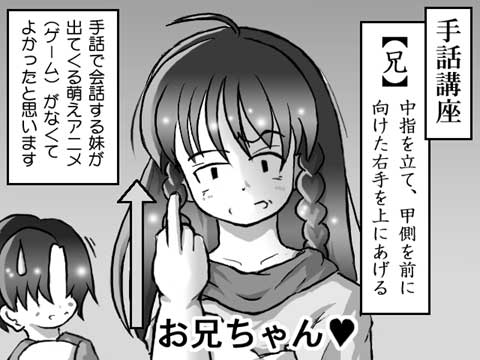
14. giving someone the finger means 'brother' in JSL. giving them the double finger means 'brothers'
there are a MILLION, BILLION more things i'd like to say, but i have to go back to my studies now.
Monday, April 18, 2005
Not for the faint of heart...
Wednesday, April 13, 2005
BIG GEI EKI
Tuesday, April 12, 2005
BIG GEI CHIRASHI
Saturday, April 9, 2005
B on the table

Friday, April 8, 2005
Once upon a time, while the sakura where in full-bloom...

Once again, 'hot shit' be 'kickin' over on David's blog.
"therefore, i invite you to 'meld with the logos of japan' [i can't figure out if this sounds like yoda or mr. spock], surpass 'Either/Or' and join the company cloistered few of who occupy ourselves with the 'Neither/Nor' of japan on a daily basis."
- Robert (to Momus, but...)
"...but hail the Japanese "leapfrog" toilet, the washlet, which takes the best of Western technology and makes it better. Hybrid, ne?"
- Nick, the artist formerly known as Mo-masu (to his own butt)
"Well fights don't break out much in Daikanyama."
- David (to Nick's butt)
Potty mouths
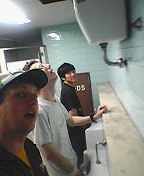
[Pictured from closest to furthest away: Robert (pre-twirl), Digiki, and Tetsuya
This week, Momus said this on his blog: During the Showa period (1926-1989) Japan had three different toilet styles...[of course, true to form, he "forgot" to talk about the immense LACK of access to toilets for the physically challenged in Japan. Whoops!]
And on a related note, I say: There is more than one way to "Japanize your ass!"
A year ago on GST
Some recent comments about GST

"Robert? His commentary often takes the form of visual or verbal provocation with little explanation. His blog seems like snapshots of a life lived in the fourth dimension."
- Roddy Schrock

"Have you looked at his blog? Every third entry is 'and here's another shot of me with my twirly mustache'! The man is a cross between a mirror, a broadcasting tower, and a bottle of Scotch."
- Nick "Japanize? My ass!" Currie

"GlitchSlapTko is SO 'in' right now it isn't even funny! Plus his stick twirlin' is the very antithesis of cliche PoMo drumming."
- David Marx

"I wish I could use 'the N. word' with as much duende as Robert."
- Jean "Pink Hamster Group" Snow
TDR raps!
Best song I've heard all day is over on TDR
http://www.harmful.org/homedespot/newtdr/NEWtdrARCHIVE/warusaruMP.mp3
http://www.harmful.org/homedespot/newtdr/NEWtdrARCHIVE/warusaruMP.mp3
Wednesday, April 6, 2005
JAPAN IS SAFTEY 2
JAPAN IS SAFTEY 1