Friday, December 31, 2004
TOSHIKOSHI
Wednesday, December 29, 2004
YO,WHAT'S UP REIKO UNDERWATER?

YO,WHAT'S UP SHIMOKITA?
ARRR,WHAT'S UP MATEY?

WHAT'S UP SAWAKO?

YUKI

Tuesday, December 28, 2004
THEY AREN'T HERE,THIS IS'NT HAPPENING!
I'M NOT HERE,THIS IS'NT HAPPENING!

葉隠れ as an ethical foil for deconstructing U.S. 'Just Wars'

As most of the regular readers of glitchslaptko know, I (Bobby D.) have been studying Mishima and his writings (both the fiction and the essays) in great detail during the past year. I view his thoughts as being essential for cutting through the current (post WWII) Gordian knot of problems with Japanese society. Naturally, there is a rich cornucopia of ideas at play in his later writings, and some of them if approached without the proper literary/historical background might seem like only the pennings of a deranged, right-wing, writer-cum-the last samurai. Not so...or rather, not entirely so.
There is a deep root of truth extant in his writings, and many of the questions and doubts he poses regarding Japanese society stand on the merits of their own arguments to be rescued from the annals of 'Modern Japanese Literature' and brought into the light of contemporary international politics. This is especially true when it comes to Japan's woeful position as a U.S. lapdog. In any event, more than 40 years old, the following passage taken from Mishima's commentary on the Hagakure (with no permission), can be read in a new and interesting way if we just substitute 'Gulf region' for 'Viet Nam'.
Naturally I'm not saying that the U.S. (state terrorist) 'wars' in that region are 'just'. Far from it. But it is interesting just as a kind of mind game to imagine that if there were a scenario in which the U.S. (or any country for that matter that enjoyed the status of 'megapower') were to wage a 'just' war, how assuming a Hagakure-esque stance to the proposition of one's own death in said war would change the way in which we might consider our involvement. Again, I welcome any and all comments from interested readers. I promise I will reply in due course.
----------
Can One Die for a Just Cause?
At this point, we must tackle the most difficult problem concerning death. Can 'righteous death', death chosen by us for the sake of a self-chosen, 'righteous' goal, can such a death in fact exist? Many young people today say they do not wish to die in an unjust war like the Vietnam war, but if they were required to die for a just national cause, or for the ideal of human salvation, they would go gladly to their deaths. This attitude is partly the fault of postwar education, especially the attitude that one shall not repeat the mistake of those who died for mistaken national objectives during the war and that from no on one shall die only for causes which one believes to be just.
But as long as human beings carry on their lives within the framework of a nation, can they really limit themselves to such righteous objectives? And even without taking the nation as a premise for existence, even when one lives as an individual transcending the nation, will one have the opportunity to choose to die for the sake of a just goal for humanity? Here must always arise a discrepancy between the absolute concept of death and the man-made, relativistic concept of righteousness. And the justness of the goal for which we die now - in one decade or several, or maybe one hundred or even two hundred years later - will perhaps be revised and overturned by history. The nitpicking and the presumptuousness of human moral judgment... [is]...in an entirely different category from death.
Ultimately we cannot choose death...We do not possess the standard for choosing to die. The fact that we are alive may mean that we have already been chosen for some purpose, and if life is not something we have chosen for ourselves, then maybe we are not ultimately free to die.
----------
Oh, where is Rousseau when you need him?
井の中の蛙

This just in from the "one small step for Robert" department. The the most important woman in my life (my mother, of course!) will be moving to Shanghai (the Bund to be exact) next year, from the Atlanta area of all places! Although we spent about one month touring China this summer together in-between two long sojourns in Tokyo, it looks like it wasn't enough for her. I guess that for me, the whole China thing was just a kind of a normal 旅, but for her it was kind of a 心の旅. (There is a nuance here that is lacking in English...) Needless to say this is a giant leap for her. Well, her excietment seems to be rubbing off on me. I think that she's planning on being there about a year at first, and then perhaps longer if things go well. It seems that I'll be getting a little 別居 of my own in the 下町 area of Shanghai out of the deal, which means that I'll probably be visiting China at least once a month. I can't even begin to express my excitement regarding this development!
A note on the language: Naturally, I have begun my Chinese studies in earnest, and have managed to locate a good conversation partner who is willing to help me with my terrible Chinese. I realize I'll never be able to master the language, but -- and I feel the same way about this as I do about Japanese -- what I'm really looking to do is see how the language will master ME. Since I was born speaking the lingua franca of the 20th century, there was really no practical reason for me to study Japanese in the first place. I approached the whole endeavor as a kind of radically transformative psychological tool, letting the natural characteristics of the way of thinking in the language map over my former English-slanted thought process/programming. Japanese isn't simply a way for me to express my 'English' thoughts in another language. I base my expressivity on what kinds of thoughts are idiomatic, and work outwards from there.
The results have been suprising thusfar. I basically have two different 'personalities' one in English, and one in Japanese, something like the old Dr. Jekyll Mr. Hyde thing. Of course I've been careful to monitor them seperately. Despite some recent accusations about my English being hard to follow, I'm happy with it personally. It is finally beginning to get just the right kind of 'flavor'. The Japanese one is also well underway. For starters, I've managed to avoid the typical 'girlish' expressions that often worm their way into the Japanese of some foreign men while at the same time cultivating a kind of strident repartee. Gagged at times certainly, but robust and peppered with bits of intellectualism and street savvy that I've been able to pick up from my all to patient friends. (Thanks, guys!) Anyway, I'm hoping to do the same thing with Chinese. We'll see where it takes me, right? In the meantime, I guess I'll be doing a few shows in China next year. I guess I'll rope some French guys into joining the whole tawdry affair just so that I can look a little less uncool. That's what friends are for anyway.
Over and out.
tête - à - tête
Also recently on GlitchSlapTKO (which has been known to take pot shots at 'Clique Opera', and at times seems oddly obsessed by this blog)
My odd obsession with CO will end the very second that I concur with at least more than half of what it says about Japan. Until then, the folks out there need a second opinion quite badly, I think.
The real Momus would not have fallen silent at that point.
True enough, but the fictional Momus had to catch a train, so...
He would have raised Plato's famous condemnation of artists. Plato thought painters were 'mere grinders of multi-coloured drugs' and called poets ignorant imitators and braggarts – flatterers, seekers of public approval, emotional con-men. If Japan were The Republic, a b-boy glitch-slapper like Bobby D would long ago have been escorted to the airport by Plato's philo-police.
Sticks and stones. Even though I've been called a lot worst that that before, how dare you insinuate that I'm an...artist! Take it back this instant, young man! Oh, the humanity of it all...
Your turn now.
Kiss,
R.
P.S. Thanks for all the props regarding my pennings, kids! I promise to keep it real.
He translated it, but will they come?
A few days ago, I went to another interesting engagement. The 13th meeting of the 鉢の木会勉強会篇, which is a kind of thinktank founded with the sole purpose of creating a kind of 'synergy' among its members, who are all into quite different things (philosophy, music, shooting guns, whatever). There was another, historical group that went by the same name (yes, Mishima WAS involved), and my friends have taken their inspiration from it. Actually, I'm not a member myself, but I was invited there by my friend Ei-Ichi, who is one of the founders (he is also teaching philosophy at an 'Ivy League' universty here in Tokyo, his focus being Hegel) . Two nights ago, they wanted to discuss some of the things that have been happening on Marxy's blog (the Nihonjinron stuff) and also some of the stuff on my blog. So Ei-Ichi, kind soul that he is, did a quick translation of some of the main points, so that Japanese folks who weren't so confident in English could follow what was being said. I've posted the Japanese version of the Marxy stuff below, just in case anyone out there might need it. Feel free to use it as you will. Post your feedback here, please. Thanks Ei-Ichi!
----------
第13回鉢の木会勉強会篇
「ロバートとマルキシーの日本論」
野尻英一
04.12.27
Robert の 'GlitchSlapTko' http://glitchslaptko.blogspot.com/
Marxy の 'Neomarxisme' http://www.pliink.com/mt/marxy/
Momus の 'Click opera' http://www.livejournal.com/users/imomus/
1. マルキシー(Marxy)のBlogサイト「Marxisme」より、「A Last Defence」と
題されたマルキシーのテキスト(超訳) November 12, 2004
「最後の弁明」
ここのところ、私の日本観について攻撃がなされてきた。私が日本を「憎んでい
る」だとか、比較の仕方が「自民族中心主義的」だとかいう批判である。(奇妙
なことにもっともはげしい非難はすべて日本に住んでいない日本ファンから来て
いる。さらに支持票のすべてはこのまっとうな島国の住民から来ている。)私は
そうした批判は歓迎する。私は自分のエッセイでは独断論を展開するのではなく
、対話を目指しているからである。今回の私に対する非難の一斉射撃は、私自身
の立場を改め、発展させる助けになるだろう。
ここで、日本についての私の立場を明確にするために、私の基本的な見解をリス
トアップしておく。
1)「日本的文化」と思われているものの大半が、19世紀における西欧思想の流
入の後に生み出されている。その中には、終身雇用、国家神道信仰、ハローキテ
ィー的幼児的文化、日常的な白米摂取、社会経済システムを過剰に規制する込み
入った法体系などが含まれる。私は慶応大学と早稲田大学の合気道の試合を見に
行ったことがある。それは非常にきびしくかつ「伝統的」なイベントだった。日
本人の男性たちが19世紀プロシアの制服に身を包み、応援と校歌の斉唱を指導し
ていた。それらはすべて19世紀ドイツの教会聖歌だった。もしわれわれがあらゆ
る文化を人工的に生み出された構造の所産として考えるならば、ある文化と行為
を強制し形づくっている構造を批判したからといって自民族中心主義であると言
うことにはならない。
2)日本は経済的に斜陽である。私が書物で読んだかぎり、ここ日本での最近の
経済の伸びを、将来の復興の良い兆しを示すものだと考えている人は誰もいない
ようである。最近の状況は、中国経済の過熱の一時的な揺り戻しにすぎない。こ
れは若者の小遣い的には厳しい状況である。日本のレコード業界が毎年一割のペ
ースで縮小を見せていることはこれと無関係ではないだろう。日本の社会経済的
システムはすべて国家が高度経済成長状態に常時あることを前提として形成され
ており、この体制は日本が直面している現在の状況からの復興には全く適してい
ない。この体制は、エコノミストや学者がもっとまともな社会政策を提起するこ
とによってのみ批判されうるだろう。それに関して言えば、私はずっと日本的体
制のもっとも良い部分、賃金の社会的な平等性、高度に適合した人的資本などの
長所を生かさないような体制は疑問であると、言い続けてきた。
3)日本の文化は権力を握った権威主義的なエリートによって生み出されてきた
。マルクス主義に傾倒している者は拒否するかも知れない。しかし、日本は50年
前まで実際に権威主義的な政府を持っていたし、民主主義の思想的な土台につい
ては自前のものはごくわずかしかなかった。教育や公共政策、行政的な説明責任
や商業を指導する機関の大半が、あからさまな帝国主義的な内容はぬぐい去って
はいるものの、わずかな修正だけで実質以前の帝国主義と同じ内容を保持してい
る。日本人は「批判はしない」。なぜなら批判することは日本的ではないからだ
、と日本人は言う。しかし、批判表明の欠如によっていったい誰が得をするとい
うのだろう。まず第一に、政府官僚は誰に対しても責任を持つ必要がなくなる。
企業も得をするだろう。(欠陥製品などについて)クレームをつける消費者は、
世界の他の地域と比べると日本では驚くほど少ない。集中統制主義の文化は、も
し政府とマスコミがその利潤への信頼を食い物にしているという事実がなければ
、まったくすばらしいものである。行儀の良い子供の集まった部屋では、いじめ
っ子たちが行動計画を決める。
4)私が日本の衰退をペシミスティックに喜んでいるのは、未来を楽観している
からである。カール・マルクスと同じように。55年体制はもはや日本では機能し
ない。私は55年体制は解体されるべきだと思っている。官僚たちは権力にしがみ
つき、システムの腐敗に寄生している。彼らはけっして自発的にはものごとを変
えようとしないだろう。しかしながら、日本の衰退はもしかすると、選挙で選ば
れる政府に日本の国民が変化を要求することにつながるかもしれないし、そうな
れば新しい血が入ることで21世紀に適合したシステムが再構築されるかも知れな
い。田中康夫は長野県で革新的なことを実行しており(たとえば手始めに記者ク
ラブの解体など)、広く公の支持を得ている。慣性はこの国では強い、しかし、
状況が悪くなればなるほど、大衆を動員するチャンスが大きくなる、はずだ。
2.「A Last Defence」へのモーマス(Momus)のコメント(超訳)November 13,
2004
1)「日本的文化」と思われているものの大半が、19世紀における西欧思想の流
入の後に生み出されている。
うわ、文化の弁証法にはまりこんじまったかんじだな。思うんだけど、日本が世
界に対して教える立場にあると言える、本当に魅力的な部分というのは、外来的
な要素を完全に自分たちのものにしてしまうその仕方にあるんじゃないか。日本
語には英語からの外来語がやまほどあるけど、そのほとんどはネイティブにはわ
からないよ。日本語を勉強するときには、外来語を日本語としてもう一度学ばな
きゃならない。それは占有主義(Appropriationism)に匹敵するぐらい、日本人
にとってはほとんど一つの芸術様式になっている、と言っていい。魅力と敵意、
感嘆と皮肉の興味深い混合、一つの「肯定の皮肉主義」と言えるものを内包した
ものだね。英語圏の文化が、日本文化と同じようにゆたかな両義性(冗長性)に
おいて他の文化に向かうことがないっていうのは、ぼくはほんとうに残念なこと
だと思うね。
2)日本は経済的に斜陽である。
でも、経済的な成長というのは本当に究極目的なのかな。日本の今の状態はほぼ
横ばいで、衰退でも成長でもないよ。個人的には、ぼくはスローライフ的な考え
方は全面肯定だな。ぼくたちは実際、もっと生活を楽しむことに時間を割いて快
楽主義的になることができるってことだ。サカモトは、日本は美しい三等国にな
るのがいい、と言ったよ。もしそうなって、そして欧米も後を追うようなことに
なれば、君の却下するフリーターも、実はぼくらに教えてくれることがたくさん
あることになるね。
3)日本の文化は権力を握った権威主義的なエリートによって生み出されてきた
。
もし日本に、政治家の政治に満足していない人がそんなにたくさんいるなら、ぼ
くらにはわかると思うけどな。ぼくはそんなの感じたことはないよ。ぼくにわか
っているのは、日本では人びとはほとんどの場合ノンポリで生きていて、ただ日
本では平和と環境については積極的に行動する人がたくさん見られる、というこ
とだね。まあ日本では、ぼくたちが知っているような政治は存在しないね。実際
、ぼくにとってはそれはかなり爽快なことだったけど。その反面、ぼくは日本で
はインターネットなしで過ごしたことはないよ。つまり、望むときにボタン一つ
で仲間の外人たちと政治的な議論ができるネットなしではね。
きみは、政治を追求するがゆえに日本を脱出した日本人というのを聞いたことが
あるかい? 本当にディベートや選挙活動に関わった日本人は? ぼくはパリのユ
ネスコで働いている日本人を何人か知っているけど、彼らは政治的な事柄よりも
文化的な事柄に熱心だ。今年、パリのユネスコビルにそこで働いている日本人の
友達と一緒に入っていったことがあるけど、門のところでユネスコにおける待遇
改善を求めてストライキをしている清掃業者たちのデモを通り抜けなきゃならな
かった。その友達は完全に彼らを無視していたよ。でも彼女は、タリバンが破壊
した仏像については非常に熱心だったし、ユネスコに立てられたばかりの安藤座
禅堂についても夢中だったよ。
4)日本の衰退はもしかすると、日本の国民が選挙で選ばれる政府に変化を要求
することにつながるかもしれないし、そうなれば新しい血が入ることで21世紀に
適合したシステムが再構築されるかも知れない。
個人的にははなはだ疑問だね。ぼくたちが大変動をうまく乗り切ったとして、21
世紀には、すべての国家は平和で、日本みたいにどこか女性的な消費文化の国に
なっていて、そうした文化が「新しい政治」になっているほうがずっと可能性が
あると思う。もしそうなるとすれば、ぼくらがいま日本で目にしているものを10
年後、20年後の欧米で目にすることになるかもしれない。マルキシー、ぼくらは
未来を覗くために君のblogを読んでいるのさ。没落する帝国の終末をかいま見る
ためじゃなくね。
3. マルキシーによるモーマスへの反論 November 13, 2004
1)日本文化は外国文化を受容する、それはすばらしいことだ、しかし、それな
ら、なぜ彼らはこうした輸入を伝統的な日本文化の背後に隠すのか。批判と学識
とはともにこうした(日本文化は外国文化を受容するという)神話を解体するの
に有効なはずだ。
2)経済的な成長は究極目的ではない。しかし、高収入を平等に分配する責任は
ある。もし日本が成長をとめるなら、収入の不平等が急激に広がるだろう。フリ
ーターの若者たちとサラリーマンを比べてみよ。これ一つをとっても、戦後社会
構造の大きな変化にあたる。「フリーター」は、欧米では「経済的な無責任状態
」と呼ばれるものだ。彼らは親に養ってもらっていて、将来の安定性に関しては
絶望的な状態にある。アメリカでは、どんなときでも、能力のある者は大企業へ
の就職が得られる。日本では、雇用制度はいまだに大卒資格と直接に結びついて
いる。だからフリーター世代の最大の夢は、店長や中下流階級の何かになること
なのである。今後われわれは、大量の中上流階級の子弟が中下流階級に移動する
のを目にすることになるだろう。それとともに、日本は消費者社会へと移行する
。
3)やかましいマルクス主義者にはなりたくはないが、しかしこれについて言え
ば、日本人がノンポリなのは彼らがノンポリになるように教える教育とメディア
のシステムを持っているからなのではないのか? 日本人の政治への無関心は、第
一に彼らが学校で批判的、懐疑的になることを教わったことがないからであり、
第二に政治的な行動はメディアがそれを報道しないように義務づけられているた
めに舞台裏で起こっているためである。このような構造をもった社会に生きてい
れば、政治的な言説も少なくなろうというものだ。60年代には日本ではものごと
は不安定だったので、大きな政治運動があった。しかし、ひとたび、社会主義者
たちが敗北し、国が豊かになると、次の世代はたちまちそれを忘却したのである
。
4)私も日本こそが未来であったならばよいと思う。しかし、私が目にするのは
障害物の山と凋落の傾向だけである。もう一度言うが、私はかつてまったく日本
の支持者だったし、よろこんで日本のやわらかい急所のいくらかは見逃しもしよ
う。しかし、いま現に私は、私がかつてとても好きだった文化産業の崩壊のさな
かにいる。
野尻
Monday, December 27, 2004
With meathooks like those, it has to be true!

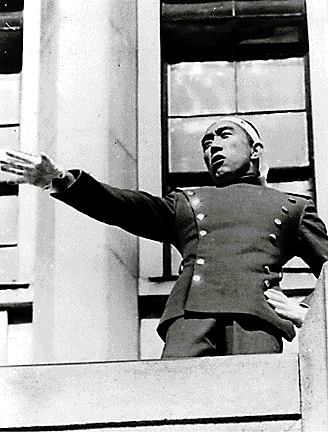
This week I'm reading Mishima's commentary on the Hagakure 「葉隠れ」 (the 'secret' book penned in the 18th century by Jocho Yamamoto) titled 'The Saurai Ethic and Modern Japan'. Mishima wrote this commentary a few years before his suicide, and many see this as his extended suicide note. I am not that concerned about the stardom of his life, or the sensationalism surrounding his demise. The spiritual and philosophical underpinnings are what I'm after.
His observations are a superb foil to some of the 'Nihonjinron' writings that I've recently been exposed to on Japan by non-Japanese (you know who you are). In a nutshell, I think there are two Japans: one that is often debated about with much sound and fury, and another Japan that even its own society has tried to repress. These are the ideas of the Hagakure, and for the majority of 'gaijin' and modern Japanese as well, they still remain, as the title implies, 'hidden under the leaves'. Mishima turns these fallen leaves over only with the utmost of caution in his commentary.
Furthermore, his ideas resonate deeply with some of the inklings that I've been having for a while about this country. I have read most of the major works of the giants of modern Japan literature, as well as their essays, and none of them stands out more than Mishima (although Kenzaburo Oe will always be up there in my top five). This is especially true in Mishima's later writings, where the content is a wild socio-spiritial agitprop cum megalomania. Anyway, a few passages were quite striking, and I'd like to share a few of them with you today. Looking forward to hearing from anyone out there interested in discussing these ideas.
(NOTE: The following passages were translated by Kathryn Sparling.)
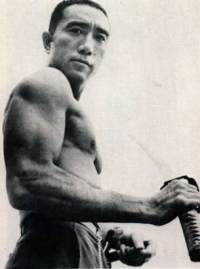
Mishima on 'Slow Life'
Ours is an age in which everything is based on the premise that it is best to live as long as possible. The average life span has become the longest in history, and a monotonous plan for humanity unrolls before us. The youth's enthusiasm for "my-home-ism" lasts as long as he is struggling to find his own little nest. All there is is the retirement money clicked up in rows on the abacus, and the peaceful, boring life of impotent old age. This image is constantly in the shadow of the welfare state, threatening the hearts of mankind. In the Scandinavian countries, the need to work has by now disappeared, and there is no more worry over support in old age; in their boredom and disillusionment at being ordered by society simply to "rest," an extraordinary number of old people commit suicide...
In modern society the meaning of death is constantly being forgotten. No, it is not forgotten; rather, the subject is avoided. Rilke has said that the death of man has become smaller. The death of a man is now nothing more than an individual dying grandly in a hard hospital bed, an item to be disposed of as quickly as possible. And all around us is the ceaseless "traffic war," which is reputed to have claimed more victims than the Sino-Japanese War, and the fragility of human life is now as it has ever been. We simply do not like to speak about death. We do not like to extract from death its beneficial elements and try to put them to work for us. We always try to direct our gaze toward the bright landmark, the forward-facing landmark, the landmark of life. And we try our best not to refer to the power by which death gradually eats away our lives. This outlook indicates a process by which our rational humanism, while constantly performing the function of turning the eyes of modern man toward the brightness of freedom and progress, wipes the problem of death from the level of consciousness, pushing it deeper and deeper into the subconscious, turning the death impuse by this repression to an ever more dangerous, explosive, ever more concentrated, inner-directed impulse, We are ingoring the fact that bringing death to the level of consciousness is an important element of mental health.
Mishima on 'Ideal Love'
The art of romantic love as practiced in America involves declaring oneself, pressing one's suit, and making the catch. The energy generated by love is never allowed to build up within but is constantly radiated outward. But paradoxically, the voltage of love is dissipated the instant it is transmitted. Contemporary youth are richly blessed with opportunities for romantic and sexual adventure that former generations would never have dreamed of. But at the same time, what lurks in the hearts of modern youth is the demise of what we know as romantic love. When romantic love generated in the heart proceeds along a straight path and repeats over and over again the process of achieving its goal and in that instant ceasing to exist, then the inability to love and the death of passions (a phenomenon peculiar to the modern age) is within sight. It is fair to say that this is the main reason that young people today are tormented by contradictions concerning the problem of romantic love.
Until the war, youth were able to distinguish neatly between romantic love and sexual desire, and they lived quite reasonably with both. When they entered the university, their upperclassmen took them to the brothels and taught them how to satify their desire, but they dared not lay a hand on the women they truly loved.
Thus love in prewar Japan, while it was based on a sacrifice in the form of prositiution, on the other hand preserved the old "puritanical" tradition. Once we accept the existence of romantic love, we must also accept the fact that men must have in a separate place the sacrificial object with which to satify their carnal desires. Without such an outlet, true love cannot exist. Such is the tragic physiology of the human male.

Mishima on Japanese 「飲み会」
In Japan there is a strange convention by which ordinary human beings strip themselves of their dignity when they drink, exposing their weaknesses and baring their hearts, confessing the most embarrassing secrets. No matter how they grumble or whine, they are completely forgiven on the excuse that they have been drinking. I do not know how many bars there are in Shinjuku, but in that overwhelming number of bars "salary men" sit and drink and complain about women and their bosses. The bar becomes a small, miserable, secret-revealing place protected by the tacit mutual promise that in the morning, although they have not actually forgotten, they will pretend to have forgotten the unmanly, sloppy confessions exchanged among friends the night before.

Mishima on the 'Philosophy of Love' in Japan
The Japanese have a particular tradition concerning romantic love and have developed a special concept of romance 「恋愛」. In old Japan there existed a kind of passion with sexual overtones 「恋」 but no love 「愛」. In the West from the age of the Greeks a distinction was made between eros (love) and agape (the love of God for mankind). Eros began as a concept of carnal desire but, gradually transcending this meaning, it entered the realm of 'idea' (the highest concept addained through reason), where it was perfected in the philosophy of Plato. Agape is a spiritual love completely divorced from carnal desire, and it is agape that was introduced later as Christian love.

Mishima on 'Social Tolerance'
...a philosophy of conscious oversight has always lived in the hearts of the Japanese, at once contradicting and reinforcing their punctilious, cremonious frugality. Nowadays the proper bounds of overlooking and not hearing have been overstepped, and pretending not to notice has taken precedence over economy, resulting in a moral decay sometimes referred to as "the black fog." That is not tolerance; it is merely laxity. Only when they are founded on strict rules of morality can overlooking and pretending not to hear qualify as human virtues; when these morals have collapsed, overlooking and not hearing may become inhuman vices.
KITTY'S GOT BACK!

FERNANDO'S GOT BACK!

Sunday, December 26, 2004
Again, a strange party!
BOUNENKAI
NAMAKEMONO

Momus and Aristotle: 一期一会

Socrates: Salutations!

Momus: [trying not to ogle a way-too-loose toga] Hi.
Aristotle: You would no doubt be Momus!
Momus: Yes. And you are...
Aristotle: I am none other than the the son of Nichomachus.
Momus: As I was about to say!
Aristotle: I'm really into your blog.
Momus: Thanks. I've read a few of your things as well.
Aristotle: Hanging out in Meguro today, are we?
Momus: I just walked down the river from Nakame.
Aristotle: Oh, I just ADORE Nakame. The cherry trees are splended when in bloom.
Momus: I couldn't agree with you more!
Aristotle: [after a brief pause] Ahem. Well, it looks like your train is coming soon.
Momus: I'm afraid it is. I would have so loved to tarry with you here.
Aristotle: As would I, as would I.
Momus: Have you got an email address?
Aristotle: I'm on Mixi.
Momus: Small world! Me too.
Aristotle: I know this is a bit of a non sequitur, but...
Momus: No, no. By all means.
ANNOUNCEMENT: [The soothing, high-pitched tone of a Japanese woman's voice may be heard coming from the loudspeakers on the platform] まもなく、二番線に新宿、池袋方面...
Aristotle: Well, frankly speaking, I really wish you'd tone down the anti-Platonic tenor of your blog.
Momus: [his feathers slightly ruffled] Really!?
Aristotle: Um-hum. I mean, sure...I've had MY little falling outs with Plato over the years and all, but you and I both know that Plato never intended for his timeless contemplations on Metaphysics, which were just honest inquiries in the realm of thought at the time, to be grossly misappropriated 1000 years later by the Fathers of the Church and poorly translated into Latin in order to shore up the rickety philosophical basis for monotheistic religions like Christanity.
Momus: Yeah, but they made me hate my body for years and years...
Aristotle: I know. I know. But it isn't HIS fault. Instead of lambasting him for the shortcomings of his interpreters, why not praise him for his lucidity and the honesty of his thought. After all, these are two things you seem to value in your writing, right?
Momus: ...
THEIR TRAINS ARRIVE
Aristotle: Well, I must be going.
Momus: Perhaps we'll meet again?
Aristotle: [boarding his train] Perhaps. Take care.
Saturday, December 25, 2004
Flashback to 2003
SCAI The Bathhouse

As some of you may (or may not) know, SCAI The Bathhouse is one of THE coolest modern art galleries in Tokyo. As its name implies, it used to be a sento - a traditional Japanese public bathhouse - which was established in 1787. In remodeling the space, the integrity of the original structure has been preserved (which doesn't happen as often as it should here in Tokyo), he space features typical Japanese roofing tiles, over 7 meter high ceilings, and skylights providing for natural sunlight. Rock. Now instead of taking a bath, you can immerse yourself in art there. All of the hardcore 「谷根千」 kids have already been there, no doubt. SCAI has been exhibited the works of prominent artists, such as Tatsuo Miyajima, Masato Nakamura, Anish Kapoor, Julian Opie, Lee Bul, etc. and they also hold lectures, performances, films, etc. The funnest thing to do is fill out a little questionnaire at the gallery across the street, they will loan you a rad bicycle for a couple of hours. Then you can tool around the 下町 in style. Kudos!
CRAZY PARTY

FERNANDO AND MAMI AT MI CASA
Friday, December 24, 2004
THANKS FOR THE TRABA LENGUAS,FERNANDO!!!

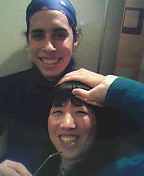
This is a picture of my new friend Fernando. This is his first time in Japan. He is from Columbia. He is visiting his girlfriend (who is Japanese) in Saitama this month. They haven't seen each other in over a year. He'll be here until mid-January. It was very difficult for him to come to Japan as a tourist. There are many reasons for this. The main one is fear. I do not like fear. Fear feels the same way about me. His girlfriend tried very hard, and so he could get to come here. Fernando is bright, witty, well-educated, and very funny to talk to. He bought his jacket (the one in the picture) in Japan. It is very 'ghetto' and I love it. He doesn't know what it means to wear such a jacket in Japan. I love it. I will not tell him yet. He is good at 'traba lenguas' which are 早口言葉 in Spanish. I like learning those in any language, but I failed Spanish in high-school. He has new, bright eyes for this country. Since I am his new friend, I can borrow them when we drink together. Last night we drank a lot. We went up on my roof and looked at Tokyo Tower and Roppoingi Hills and the spotlights from Odaiba. The pictures in his camera are super. I will upload them soon here. Over and out.
New shit
DJ KICK has his new shit up. Go get it while you can.
Jean has got this pic up about 'one of those traffic dummies.' In case you were wondering, they are called 「安全太郎」,which is pretty funny actually. (I tried leaving this little gem in a comment on his site, but i keep running into an error.)
Thursday, December 23, 2004
NO SNOW

Wednesday, December 22, 2004
I'M AT THE STRANGEST PARTY RIGHT NOW!
Monday, December 20, 2004
MR.SHIGETA'S KARAOKE RAWKS!
GO FORTH!

俺、鶯谷ぞっこん!

Friday, December 17, 2004
THANKS FOR THE RAMEN,MAS!
Tuesday, December 14, 2004
今年の漢字 - A different sort of character expo.

Any attempt to engineer in the tabula rasa that is the 21st century Japanese psyche an overarching cosmological theory even remotely analogous to what Presocratics like Parmendies had in mind when he wrestled such concepts as his 'Way of Truth' and his 'Way of Seeming' away from the gaping, prehistoric maw of 'mythos' would doubtless smack of a wanton philosophical retrofitting. Such follies will be forgone here. Conversely, to blindly insist that Japanese culture is totally devoid of its own kind of functional metaphysics would prove an even more grandiose study in spuriousness. The supergravitational pull of an oriental 'deus ex machina' does indeed exert a sure and steady pull...even on the gossamer-like flutterings of the denizen of that chimerical, sugar-coated superflatness known as Tokyo.

Monday morning in Kyoto, during a ceremony to which declared the Japanese kanji best symbolizing 2004, the seventh and final stroke of the awe-inspiring calligraphy which poured forth from the gargantuan brush of Seihan Mori, chief priest of Kiyomizu Temple, completed the ideogram 'wazawai' (disaster). This ominous kanji garnered 20,900 out of 92,000 votes in the Kanji of the Year contest organized by the Japan Kanji Aptitude Testing Foundation, indicating disasters like the Niigata earthquakes of late October, the controversial SDF deployment in Iraq earlier this year, and the widespread flooding in Japan. The other kanji rounding out the top five or this karmic basso continuo chosen by popular vote were: 2) 「韓」 (the 'Hanryu' cultural boom from Korea), 3) 「震」 (the nationwide earthquakes), 4) 「金」 (the ongoing financial woes), 5) 「新」 (note: various interpretations are possible here). Curiously enough, no direct mention was made of the pleasures of corporeal indulgence...
Monday, December 13, 2004
YO,REPRESENT'N ONTOLOGY!

Saturday, December 11, 2004
The Library of Babel - A few recent entries

My Individualism and The Philosophical Foundations of Literature - Soseki Natsume
The Samurai Ethic and Modern Japan - Yukio Mishima (on the Hagakure)
Presocratic Philosophy: A Very Short Introduction - Catherine Osborne
YO,REPRESENT'N NAKAME!
NEW BOOK
Friday, December 10, 2004
THANKS FOR THE HAT,MOM!

My new favorite (old) CD is...

Yesterday I happened upon the diskaholics anonymous trio's (Mats Gustafsson - tubax, ts, french flageolet; Jim O'Rourke - syn, computer; Thurston Moore - g) debut CD (2000) for sale at BOOK OFF over in Sangenjaya! This is great, robust stuff, kind of in the same vein as the FLOSSIN album (I reviewed it here a while back) but must, must better. I'll do a proper review sometime this week, but for now, all I'd like to mention that everybody out there is saying that this music's genre is 'Unclassifiable' but I couldn't disagree more! It is very CLOSELY related in terms of raw sound, to the 'Intuitive Musik' (or 'la musique intuitive', take your pic) of Stockhausen. I'm thinking here specifically of his 'composition' Aus Den Sieben Tagen. 'Fais Voile Vers Le Soleil', a track on this CD, is one of my all-time favorites, and it bears a striking resemblance to the diskaholics sound. Anyway, if you have a chance, check it out. More later!
Shame on YOU, Nick!

Nick is up to his old tricks again! Just when you thought that semi-sighted archer of ideologies might be learning his lesson, he has let fly with another warped shaft of a blog entry. In an effort to hyper-beautify his favorite race (the Japanese), and lampoon his least favorite one (his own), he has shamelessly penned what promises to be his most one-dimensional (i.e. Superflat) blog entry yet!
No doubt Sachie Kanda (peace be upon her) really DID record the opinions the Japanese folks expressed over on Pop Vox. Furthermore, I will not claim that the opinions proffered by the 'gaijin' were not what they were (pretty nasty). However, I'm mostly interested in Nick's overactive imagination. Recently, Clique Opera has displayed a true penchant for wantonly juxtaposing the 'creme de la creme' of Japanese society with the virtual 'dregs' of American ex-pat society in Japan. There are more bad (Japanese) apples out there than you are willing to admit, Nick...but you seem to have no problem crying 'foul' when you see even the slightest 'gaijin' infractions. Granted, the comments you quote ARE vehement...but things are not that simple over here, sir.
Naturally such undesirables DO populate this city, but I think it would be better for everyone (especially the readers if CO) if he toned down the hyperbole (it looks better on me than it does on him anyway) a little, and try to offer up more inclusive, moderate 'gaijin' views...and perhaps a few more 'radical' Japanese views. Nick, if you don't know where to look for more moderate 'gaijin' views, or even 'volitile' Japanese views, why not just ask? I'd be happy to point you in the right direction(s). Sadly, this little excursion will take you well outside of your usual happy hunting grounds. Game?
Anyway, any argument appearing THIS rock solid (in this case a one-sided portrayal of 'gaijin' as the 'barbarians at the gate') can't be anything more than a rudimental study in contrast thrown up on a foundation of pure kaka. I want to know WHERE exactly it is they were doing this survey and also the info about the demographics of the 'gaijin' who responded. They sound like white, American males to me...and I've already shown how this, in Nick's mind at least, it THE definition of 'gaijin'. Where are the others? Far be it from me to remind anyone that to fit the definition, a 'vox populi' should uphold the opinions of actual ORDINARY people. I think that the Japanese opinions expressed were 'ordinary' insofar as their judiciousness is concerned, but obviously the 'gaijin' who took the time to comment (from their computers) can't possibly represent anything other than a kind of 'fringe' element, can it?
Also, just to be fair, I'd also like to see Sachie do the actual footwork and get out there on the street and ASK some actual non-Japanese in person what their answers would be, since we all know that folks tend to display considerable abandon when posting up comments to a website. Hummm...unless she does at least this much over on her Vox Pol, the writing that Nick did today based on her incomplete survey can only give new meaning to the phrase 'yellow journalism'. Tut-tut.
Thursday, December 9, 2004
OUR RITE MAN VICE!

YOUR MY FAVORITE INHUMAN DEVICE!

YOUR MY FAVORITE HUMAN DEVICE!

YOUR MY FAVORITE POISON,BITCH!

YOUR MY FAVORITE POISON,BITCHES!

YOUR MY FAVORITE POISON,KIDDO

YOUR MY FAVORITE POISON

Wednesday, December 8, 2004
験なき恋/A Yearning With No Requite

験なき恋をもするか夕されば人の手まきて寝らむ児故に。
- 読人不詳(創業760年頃)
I have fallen into a yearning with no requite,
for a girl who, when night comes,
sleeps pillowed in another's arms.
- Anonymous (circa 760 A.D.)
X-mas sugardaddy?
Tuesday, December 7, 2004
Props
HOLIDAY EVENT

Anyway, the frog will be doing some tunes with he NEW HIP-HOP (the mysterious Frenchman in question + 'Jujin'). I'll be doing a kind of messed-up DJing set (no computer, just some 45s, some trick arrows, and a lot of love) under my new alter ego, The Black Archer. (My new 'special friend' The Black Widow may also be making a special appearance.)
You can email this addy [squelette20 at hotmail dot com] to get the lowdown on the event. There'll be lots of merrymaking and "Ho, ho, ho's" (hint, hint), so I hope to see you there. Me? I'll be the one there with bells on.


